Note:
This is a note to help you collect the information for passing a CASA flight test ground component.
You may download the test form of CASA, e.g. google search: casa cpl test form .
And you may check Part 61 Manual of Standards for required items
https://www.legislation.gov.au/F2014L01102/latest/text/4
For the AOC part in CPL flight test ground component, you also need to check your company’s AOC exposition.
Contents
About licenses grant, requirements
Carriage of documents, weather etc.
Special flights – over water, remote
CAO 48.1 Appendix 1 Fatigue Management
Requirements for an AOC ( CASR 119.D-J )
Content of exposition CASR 119.205
License
About licenses grant, requirements
Grant of flight crew licenses
People who may grant
CASA: flight crew license, rating, endorsement
Flight examiner:
most ratings, except categories, flight examiner …
most endorsements, except flight test
Instructor: some endorsements, except that requires a flight test.
General Obligation of flight crew license holders
Personal logbooks – pilots
Commits an offence if not keeping a logbook
Full name and DOB
As soon as possible after completing each flight
Retention of personal logbooks
Retain for 7 years after the last entry
False entries in personal logbooks
Comply within 14 days after direction is given
Production of personal logbooks
Within 7 days after the direction is given
Printed copy, each page of is certified
Pilot licensing – general limitations and authorizations 61.E
General limitations on exercise of pilot license privileges 61.E.1
Ratings 61.375
Aircraft category rating
Aircraft class rating
General competency requirement 61.385
Competent in operating the aircraft to the standards mentioned in the Part 61 MOS
Including:
Navigation and operating systems
All normal, abnormal, emergency flight procedures
Operation limitations
Weight & Balance
Aircraft performance data, including takeoff and landing performance data.
Recent experience for certain passenger flight 61.395
Carrying PX by day:
WI previous 90 days, in ACFT or approved flight simulator for the purpose, by day or night
3 takeoff and 3 landings
While controlling the ACFT or simulator
Carrying PX by night:
WI previous 90 days, in ACFT or approved flight simulator for the purpose, by night
3 takeoffs and 3 landings
While controlling the ACFT or simulator
Each takeoffs must followed by climbing to 500’ AGL
The holder is taken to meet the requirements if
WI previous 90 days, in the …., holder
Successfully complete a relevant check or review or
Passed a flight test for a pilot license or rating on a pilot license
That includes 1 takeoffs and 1 landings, (by night if for night)
Flight reviews 61.400
Flight review for a rating on a license:
Demonstrate competency mentioned in 61 MOS for the rating
to CASA/61.040/instructor who is authorized to conduct a flight review for a rating
in an ACFT flown under the rating/ approved flight simulator
Medical certificates: CPL, multi-crew, ATPL holders 61.415
Current class 1 medical certificate
A medical exemption for the exercise of the privileges of the license.
However, CPL/ATPL are authorized to exercise the privileges of the license in an activity that would be authorized by a PPL if the holder holds current class 2 medical certificate
CPL/ATPL are authorized to exercise the privileges of the license in an activity that would be authorized by a RPL if hold current recreational aviation medical practitioner’s certificate and meet relevant requirement.
Must not exercise the privileges during temporary medical unfitness that affects safety.
Carriage of documents, weather etc.
Carriage of documents General
Crew Member: 61.420
License
Medical
Photo ID or passport
Aircraft:
AFM
Computerized Navigation Equipment – Operating Instructions
MEL
For certain flights not: Day VFR WI 50 nm; TA of route to TA
Authorized Aeronautical Information
MR or flight technical log ACFT
Forecasts for flight planning 91 MOS 7.02
Before commencing flight, must study:
Authorized weather forecasts(30min – ETA – 60min) and reports for:
The route, departure/destiantion/ALTN
Other reasonable available weather information relevant to intended operation
Unable to obtain authorized weather forecasts 91 MOS 7.03
May commence a flight if:
Forecasts and reports not available &
Consider safe to return and land at DEP AD WI 1h
Must return to DEP AD if:
not obtained WI 30 min after DEP &
no ALTN AD
Limitation on exercise license privileges - Carriage of documents 61.420
1. License
2. Medical(dependent on your license): Class 1 or class 2 Medical certificate, recreational aviation medical practitioner’s certificate, Medical exemption
3. Photo id:
full face, head, shoulder
within 10 years, by government
valid
Only for PPL License
Privileges of private pilot licenses
As PIC or co-pilot of
Private operation
Receiving flight training
Limitation of PPL on multi-crew
Multi-crew operations requirement:
Only if completed an approved course of training in multi-crew operations
Requirements for grant of private pilot licenses – general
At least 17
PPL and aircraft category rating
Passed aeronautical knowledge exam
Complete flight training
Passed flight test
Met aeronautical experience requirements (at least 35 h; with one trip 150 nm 2 AD full stop)
Only for CPL License
Commercial pilot licenses
Privileges of CPL 61.570
As PIC of any ACFT in any Ops other than:
In Air Transport:
Multi-crew
If less than 750h, single pilot ops MTOW>5700kg
Copilot of any ACFT in any Ops
Limitation of CPL on multi-crew ops 61.575
Multi-crew operations requirement:
Only if completed an approved course of training in multi-crew operations
Requirements for grant of CPL – general 61.580
At least 18
CPL and Category Rating:
Passed aeronautical knowledge exam
Complete flight training
Passed flight test
Met aeronautical experience requirements
|
140 |
70 |
20 |
10 |
5 |
|
Total |
PIC |
Cross-country |
Instrument |
Instrument in Aeroplane |
Include a trip 300nm 2 Full Stop AD out of TA
if hold ATPL, meet that category
Ratings and endorsements
Aircraft ratings and endorsements for pilot licenses
Aircraft category rating 61.730
Must be a holder of license
If application is at the same time of applying license, met
Aircraft class rating 61.735
Privileges:
Is authorized other than:
Certified for multi-crew
Single-pilot type rating required
Flight review 61.745
Authorized only if with valid flight review
Expire At the end of the 24th month after the month flight review was completed
If due to expire within 3 months, …., at the end of the 24th month after the validity of the previous flight review.
Requirement for grant of aircraft class ratings 61.750
Must hold pilot license
Category rating which that class belong
Completed flight training for the rating
Passed flight test Part 61 MOS for the rating
(However: MEA class rating requires a PPL, CPL, Multi-pilot license or ATPL)
Design feature endorsements 61.755
Following features require endorsement:
Tailwheel, retractable undercarriage, Floatplane/float hull, Ski landing gear
Manual propeller pitch control(piston)
Gas turbine
ME center-line trust
Pressurization system
Other ratings:
Pilot type ratings
Cruise relief type ratings
Instrument Ratings
Private Instrument Ratings
Night VFR ratings
Night Vision imaging system ratings
Low-level ratings
Aerial application ratings
Flight activity endorsements
Pilot instructor ratings
Flight examiner ratings
ACFTS & OPS
Equipment
Flight Instrument
VFR flight by day
IAS
Pressure ALT
MH
Time(accurate hh.mm.ss)
Mach number - only for limitations expressed in Mach number
Turn & Slip – only for AWK
OAT – only for AWK, FM AD that ambient air temp not avail.
VFR by night
IAS
Pressure ALT
MH
Time
Turn & Slip
OAT
Attitude
VSI
Stabilized heading (DI)
Showing supply of power to gyroscopic instr.
Aid: Approved GNSS or ADF or VOR
Emergency Equipment
ELT requirements
Transmit in both frequency 406 MHz, 121.5 MHz
Registered in AMSA
ELT carriage
More than 50 nm from DEP AD
If installed in ACFT: must be armed before flight
If survival(portable) ELT: must carried in a readily accessible place
Exceptions:
Within 50 nm
Single-seat ACFT
For the purpose of:
ACFT Manufacture
Delivery, transfer ACFT after purchase
From outside AU to where required
ACFT able to continuously communicate to appropriate person on ground
For the purpose of fitting the ELT, provided:
Entry been made on ACFT logbook
Placard for ELT not installed to pilot
Not more than 90 days since removed
Special flights – over water, remote
Flights Over Water
OW flight Notification
VFR flights, either Air transport or flight OW greater than glide range:
Submit flight plan
Nominate SARTIME
Leave a flight note
Life jackest
Carriage requirements
For:
Seaplane or amphibian
Single-engine not seaplane or amphibian OW beyond glide range
MEA not seaplane or amphibian more than 50nm from suitable land
Exception:
T/O, Landing, Climbing, descending for AD
Must carry:
A life jacket for each person and infant that have a whistle
Wearing requirements
Wear if:
Single-engine: OW beyond glide range, not higher than 2000 ABV water
Exception:
T/O, Landing, Climbing, descending for AD
Life rafts
Must carry if OW more than:
30 min of till air cruise, or
100 nm
Signalling equipment
Single-engine OW:
Must always carry survival ELT if fly OW beyond glide distance
Exception:
Single-seat
With continuously communicate to appropriate person on GND
Delivery, transfer ACFT after purchase
Positioning from outside AU to where AMSA ELT is required
More than 1 life raft required:
Automatic ELT and survival ELT, or
2 survival ELT
Survival Equipment
Where life raft required
Remote areas
Human & Cargo
Seating and carriage of persons, cargo, animals and firearms
People
Crew: 1 on pilot seat, seat belt fastened
Must not assign no seatbelt seat, unless MOS
Infants: not turned 2
In arms or lap of an adult
Adult seatbelt not fastened around infant
Restrained using supplemental loop belt, infant seat belt
Children: turned 2 not turned 13
Max 2 children sit side by side
Combined weight does not exceed 77 kg
Seatbelt restrains both children in seat
Safety when aeroplane operating on ground
The person who starts or causes the engine to be started must be:
Authorized to pilot the aeroplane under Part 61 or taxi the aeroplane under Part 64
Contravenes if allow another person onboard while pilot seat is not occupied by a person who is competent to apply brakes and control the engine.
Safety Directions by PIC
When:
Before taxing, takeoff, landing
It’s necessary for safety
Direct passenger to:
Fasten seatbelt or shoulder harness
Seat back upright
Attachments stowed
If person suffer health condition, PIC agrees not to fasten:
Safely restrained and will not affect other passengers’ safety
Passenger safety briefing and instructions
Smoking rule, prohibited place
Electronic devices limitation
Seatbelt must be worn, how to use them
Seat backs upright
Seat attachments stowed
Brace position
EMERG exits, passenger next to it able to operate, not obstruct
Oxygen
Survival equipment
Over water equipment
Pilot seat, not manipulate or interfere with control
How, where to stow and secure baggage
Jump ACFT – where people must occupy to keep balance
Carriage of Cargo
Must not allow cargo:
Damage, obstruct control, equipment essential to safety
Exceed load limitations
Obstruct aisle
Obstruct emergency exits
Unoccupied seats
Must not weighs more than 77 kg unless manufacturer allows greater weight
Must not interfere safety operation
Loading instructions
Only allow cargo to be carried where a placard with instructions for the carriage of cargo is in place
Carriage of animals
With the permission of the pilot
Ensure carrying the animal will not adversely affect safety
Firearms
May only carry or possess a firearm if pilot or operator has given consent
No person may discharge, unless permitted by regulation
Alcohol
Effects:
Affect central nervous system, slowing down ability to respond.
Proportional to BAC
CASR 91.520: Must not commence duty if they have consumed alcohol within 8 hours of the flight beginning.
Permitted level: less than 0.02 grams of alcohol in 210 litres of breath.
Check:
Do not consume alcohol 8 hour before sign-on
Do not fly while under the influence of alcohol
Do not fly if you have taken illicit drugs
Do not fly while using any drug that may adversely affect safety
If in doubt, ask DAME
Consider wait 24 h from the last use of alcohol
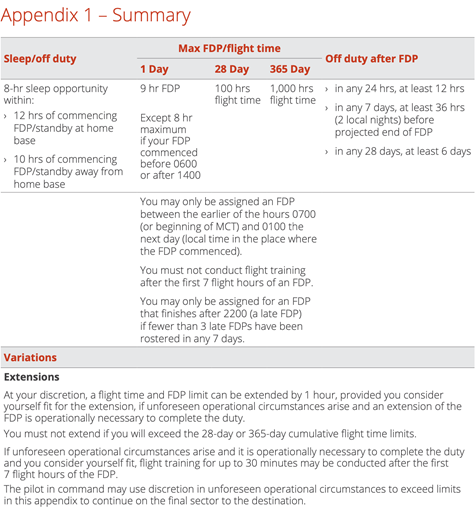
CAO 48.1 Appendix 1 Fatigue Management
Fuelling
Contaminated, degraded, inappropriate fuels
Ensure non of above(fuel drain, add Jet A1)
AIAC: 1st flight of day, after refuelling
Fire hazards
No fire hazard within 15 m of the aircraft or equipment used
Firefighting equipment
At least 2 fire extinguishers, not less than 6 m, no more than 15 m from fuelling point
Each capable of electrical and fuel fire(dry chemical)
Electrical bonding
Ensure aircraft and equipment used are electrically bonded
Equipment or electronic devices operating near aircraft
Operating of equipment or electronic device near aircraft during fuelling
Must not operate equipment or electronic device within 15 m of fuelling point
Fuelling aircraft while equipment or electronic device is operated near aircraft
Must not fuel an aircraft when equipment or an electronic device is being operated within 15 m of fuelling point
Fuelling aircraft – persons on aircraft, boarding or dsembarking
Highly volatile fuel
must not
other than highly volatile fuel
pilot or operator must hold approval to do so when a person other than crew is onboard, boarding or disembarking
AC 91-25 11.2.5 About fuel drum
When opening a drum (fuel drum)
• Stand the drum upright but tilted slightly, and chock it with the high side positioned at 12 o’clock, the bung at 3 o’clock, and the vent at 9 o’clock. This minimises water or dirty fuel on the outside of the drum from reaching the openings.
• Allow the drum to stand undisturbed for at least 10 minutes prior to fuelling to let any internal contaminants settle out.
• Proper bonding is critical. Connect the bonding lead to an unpainted surface on the drum and to the aircraft designated bonding point before opening any fuel caps, and leave it in place until all fuel caps have been replaced.
• Open the pumping bung and vent then perform a visual inspection of the condition of the drum using a fuel safe light source. Fuel in drums showing signs of internal deterioration should not be used. Next, carefully withdraw and check a fuel sample from the drums low point using a thief tube or specially designed suction device.
• Ensure that the pump standpipe cannot reach the lowest point in the drum - any small amount of water or dirt will thus remain in the drum. The last few litres of fuel should not be needed badly enough to risk using it.
Pilot maintenance
Maintenance permitted to carry out
Daily inspections
Ensure: airworthy, equipment serviceable for operation
Keys:
Before the first flight or each day
Must be signed in Part 3 MR
By Licensed aircraft maintenance engineer LAME
or pilot holds min RPL, as PIC
Perform maintenance for:
a Class B aircraft under 1988 42ZC
in accordance with CAR schedule 5 & 8
Oil requirements
Enough to complete flight safely.
e.g. DA40 min 5, max7. Depend on operator, e.g. AIAC: CCT, TA 5.5, NAV 6
Flight Rules
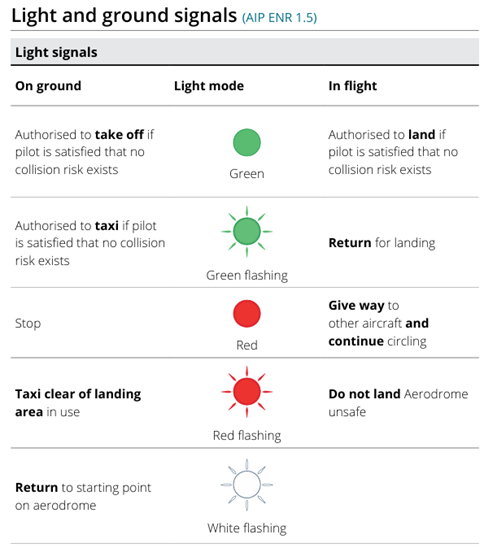
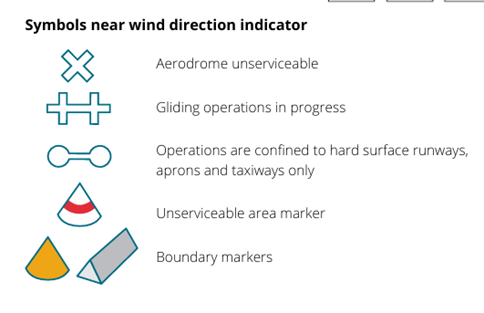
Aerodromes signals
(from VFRG)
T/O and LNG
They may ask you the required distance between you and the preceding aircraft.
e.g. You are in a DA40. If another DA40 takes off at YPMQ prior to you, when can you take off following that aircraft? (the distance required between you and your prior aircraft on takeoff)
Please refer to the 91 MOS
And it’s also good to have an impression of the followings (from VFRG)
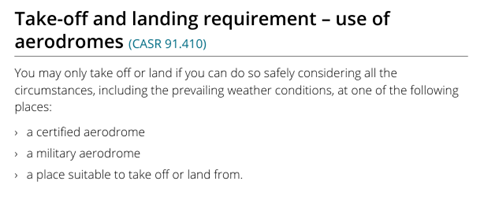
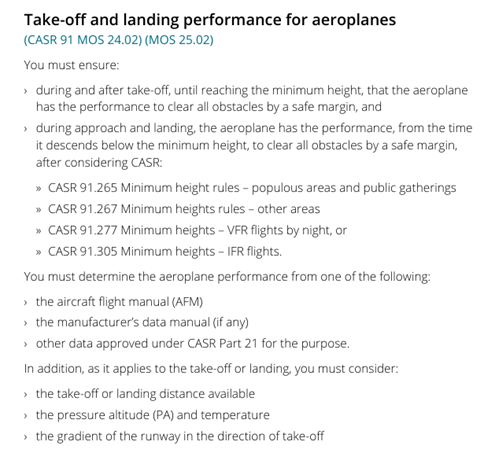

VFR rules
VMC
|
All ABV 10,000 AMSL |
8km |
1000ft V. 1500m H. |
|
All BLW 10,000 AMSL |
5km |
1000ft V. 1500m H. |
|
D |
5km |
500ft BLW CLD 1000ft ABV CLD
600m H. |
|
G BLW 3000AMSL 1000AGL |
5km |
CLR of CLD In sight of GND or Water |
Special VFR
Special VFR clearance in CTR, or CTA next to CTR
For entering of leaving CTR
Provided IFR not be delayed
Must ensure:
Clear of cloud
1600m VIS
Alternate minima
1500’ more than SCT, less than 8 km VIS, Exceeding Max XW.
VFR Nav
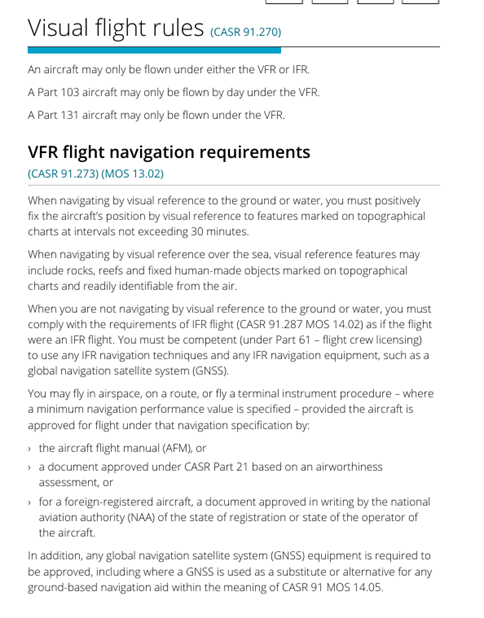
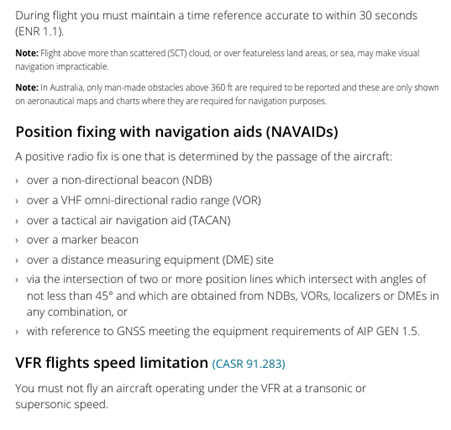
About AOC(Only for CPL)
They would assess you on the following knowledge:
1. the CASR laws about AOC requirement
2. Your company (AOC) AOC’s exposition (normally in the library, e.g. smart library). In the following, e.g., the AOC is AIAC.
Requirements for an AOC ( CASR 119.D-J )
Pilot to conduct air transport: must hold air operator’s certificate AOC
If you conduct or propose to conduct an air transport operation in Australia for fixed wing or rotary wing aircraft, you must hold an air transport air operator’s certificate (AOC). We grant these certificates under Part 119 of the Civil Aviation Safety Regulations (CASR) – Australian air transport operators.
Classification of operations
Private Operation
These are typically flights where the aircraft is not being used for hire or reward, such as personal or recreational flights.
Commercial Operation
These are operations conducted for hire or reward and include:
Charter:
This involves hiring an aircraft and crew for a specific flight, like a fly-in/fly-out service or a scenic flight.
Aerial Work:
These are operations that involve using an aircraft for a specific task, like aerial photography, agricultural work, or survey flights.
Air Transport:
This encompasses a broader range of operations for hire or reward, including charter and RPT (Regular Public Transport) operations, as well as the transport of medical supplies or personnel.
Type of information contained in an operations manual
(You need to know what information is included in the operation manual)
Operator’s name
Address
Organizational structure, corporate structure
Key personnel and reporting lines, CEO responsible matters
Register ACFT
Air transport operation conducted
Detail of each program, procedure, system
Content of exposition CASR 119.205
(You need to know what kind of contents are included in the exposition)
(1) An exposition for an Australian air transport operator must include the following:
(a) the operator’s name (including any operating or trading name), contact details and ABN (if any);
(b) the address of:
(i) the operator’s operational headquarters; and
(ii) each of the operator’s main operating bases; and
(iii) each of the operator’s operational facilities;
(c) a description and diagram of the operator’s organisational structure showing formal reporting lines, including the formal reporting lines for each of the key personnel;
(d) if the operator is a corporation—a description of the operator’s corporate structure;
(e) for each of the key personnel, the following information:
(i) the qualifications and experience (if any) required by the operator for the position in addition to the qualifications and experience required under Subpart 119.D for the position;
(ii) each matter (if any) for which the holder of the position is responsible in addition to the responsibilities mentioned in Subpart 119.D for the position;
(iii) the name of the person appointed to the position;
(iv) the name of each person authorised to carry out the responsibilities of the position when the position holder is absent from the position or cannot carry out the responsibilities;
(v) a description of how the operator will manage the responsibilities of the position during a circumstance mentioned in subparagraph (iv);
(f) each matter (if any) for which the chief executive officer is responsible and accountable in addition to the matters mentioned in regulation 119.130;
(g) an outline of the Australian air transport operations conducted by the operator under the operator’s Australian air transport AOC, including the areas of operation and routes;
(h) details of each plan, process, procedure, program and system implemented by the operator to safely conduct and manage their Australian air transport operations in compliance with the civil aviation legislation;
(i) for each registered aeroplane or rotorcraft operated by the operator under the AOC—its type and model and registration mark;
(j) for each foreign registered aircraft operated by the operator under the AOC—its type and model, nationality and registration mark;
(k) a description of the arrangements for managing the continuing airworthiness of the operator’s aeroplanes or rotorcraft;
(l) a description of any leasing or other arrangements for the supply of the aeroplanes or rotorcraft as the arrangements relate to the operational control or continuing airworthiness of the aeroplanes or rotorcraft, or to any other safety matter;
(m) a description of the operator’s process for making changes, including:
(i) identifying changes that are significant changes; and
(ii) identifying changes that are not significant changes; and
(iii) telling CASA and the operator’s personnel of the changes;
(n) a description of anything else required to be approved by CASA under these Regulations in relation to the operations mentioned in paragraph (g);
(o) any other matter required to be included in the exposition under these Regulations.
e.g. AIAC Exposition
Exposition: (You need to know what are they)
VOLUME 1 PRINCIPAL DOCUMENT
VOLUME 2 OPERATIONAL PROCEDURES
VOLUME 3 INTERNAL TRAINING & CHECKING MANUAL
VOLUME 4 TRAINING MANAGEMENT SYSTEM MANUAL
VOLUME 5 SAFETY MANAGEMENT SYSTEM MANUAL
VOLUME 6 DANGEROUS GOODS MANUAL
VOLUME 7 FATIGUE MANAGEMENT MANUAL
VOLUME 8 SQMS – MECHTRONIX DA40/42
AIAC key personnel: (You need to know who are they)
CEO: Tao Liu
HOO: Gerard Byrne
Safety Manager (SM) : Gregory Parnell
……
Other CPL theory Knowledge
There is a special focus on hazards.
From CMET
You may need to check the meteorological hazards part:
https://aviationnote.com/CMET.html
When Mountain Waves forms:
Wind direction perpendicular to the hill, speed at 25kt or more. With lenticular and rotor clouds on the leeside
Airframe Icing
Temperature factor:
Clear ice: 0 ~ -15°C; Rime ice::-10~-30°C
Determining factor for types of icing is supercooled water droplet size
Cb, Ns: larger droplets -> clear ice
Ac, As, upper section of Cb: smaller droplets -> rime ice
Thunderstorms
e.g. how far should you stay away from TS? 20 miles
From CPLA
Wake Turbulence area
1 wingspan high
2 wingspans wide
They can sink to 1000ft low, at 500fpm, widens at 3-4kts
……